

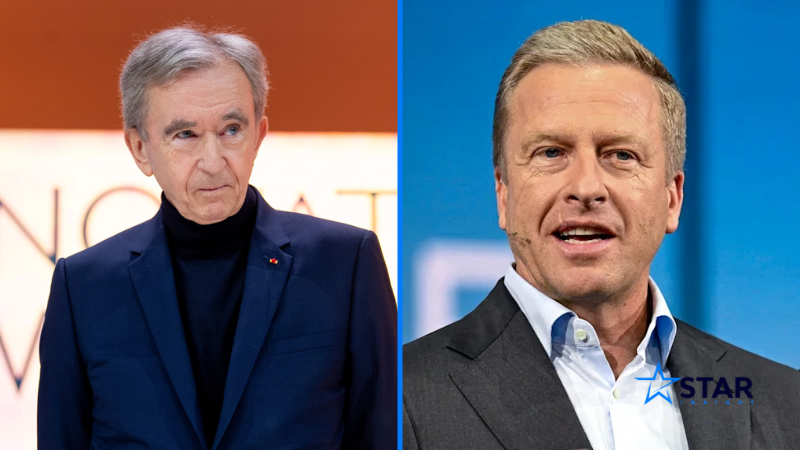
Bernard Arnault and Oliver Zipse are two well-known figures in European business, recognised for their leadership in industries that operate very differently. Arnault built his reputation in the luxury goods sector through his leadership of LVMH, while Zipse spent more than three decades developing his career at BMW, one of the world’s major automotive manufacturers.
Their professional journeys offer two different examples of business success. One is associated with acquiring, developing and managing prestigious luxury brands, while the other is known for engineering, manufacturing and corporate leadership in the automotive industry.
Although their names represent different areas of European business, both careers demonstrate the importance of long-term planning, industry knowledge and strategic decision-making. Understanding their backgrounds provides a closer look at how they developed their influence and contributed to international business.
Quick Facts: Bernard Arnault and Oliver Zipse
| Detail | Bernard Arnault | Oliver Zipse |
|---|---|---|
| Full Name | Bernard Jean Étienne Arnault | Oliver Zipse |
| Date of Birth | 5 March 1949 | 7 February 1964 |
| Birthplace | Roubaix, France | Heidelberg, Germany |
| Nationality | French | German |
| Profession | Businessman and Investor | Engineer and Business Executive |
| Known For | Chairman of LVMH | Former Chairman of BMW |
| Industry | Luxury Goods and Fashion | Automotive |
| Major Company | LVMH | BMW Group |
Note: Oliver Zipse served as BMW’s Chairman of the Board of Management until May 2026.
Who Is Bernard Arnault?
Bernard Arnault is a French businessman best known as the Chairman and Chief Executive Officer of LVMH Moët Hennessy Louis Vuitton. He was born on 5 March 1949 in Roubaix, France, into a family with an industrial business background.
He studied at the École Polytechnique, one of France’s leading engineering institutions. His education provided a technical foundation that later became useful in evaluating business operations and investment opportunities.
Arnault initially entered the professional world through his family’s construction and engineering business. However, his interests gradually moved towards larger business opportunities, particularly in the luxury goods market.
His career eventually became closely associated with the development of LVMH, a multinational group whose portfolio includes fashion, leather goods, wines, spirits, perfumes, cosmetics, watches and jewellery.
Rather than building a reputation around one product or fashion house, Arnault developed a business model centred on bringing established luxury brands together under a larger corporate structure.
How Bernard Arnault Built His Career
Arnault began his professional career as an engineer at Ferret-Savinel, the construction company associated with his family. He gradually moved into management and became chairman of the company in 1978.
His early business experience helped him understand financial planning, company operations and organisational management. These skills later became important when he moved into the luxury industry.
A significant turning point came in 1984, when he became involved in reorganising Financière Agache, a holding company connected with the Boussac group. This opportunity brought him closer to the luxury sector through Christian Dior.
Arnault recognised the commercial value of established brands and the importance of preserving their identities while improving their business potential.
In 1987, LVMH was created through the merger of Moët Hennessy and Louis Vuitton. Two years later, Arnault became its majority shareholder and chairman.
This development established the foundation for his long-term business strategy.
Over the following decades, LVMH expanded through acquisitions, investment and international development. The group gradually brought together numerous luxury businesses with different histories, products and customer bases.
Arnault’s approach was not simply to acquire well-known names. It involved developing a structure in which individual brands could maintain their creative identities while benefiting from the resources and international reach of a larger organisation.
Bernard Arnault’s Leadership at LVMH
LVMH became one of the most influential groups in the international luxury market under Arnault’s leadership.
Its business portfolio includes several well-known brands, such as:
- Louis Vuitton
- Christian Dior
- Fendi
- Givenchy
- Bulgari
- TAG Heuer
- Sephora
- Moët & Chandon
These businesses operate across different product categories, allowing LVMH to reach customers interested in fashion, beauty, jewellery, watches and premium beverages.
One important feature of Arnault’s leadership is his focus on brand identity. Luxury businesses often depend on heritage, craftsmanship, design and customer perception. Expanding a brand without weakening these qualities requires careful management.
His acquisition strategy also helped LVMH establish a presence across different markets. Instead of relying on one fashion label or product category, the company developed a broad portfolio.
This approach has made LVMH an important example of how luxury businesses can operate within a large international group while maintaining individual brand identities.
Arnault’s influence extends beyond company management. His business decisions have helped shape investment patterns, competition and consolidation across the global luxury industry.
Who Is Oliver Zipse?
Oliver Zipse is a German business executive and mechanical engineer who became widely recognised for his leadership at BMW Group.
He was born in February 1964 in Heidelberg, Germany. His educational background includes mechanical engineering at the Technical University of Darmstadt, along with studies in computer science and mathematics at the University of Utah.
He also completed an Executive MBA through the Kellogg School of Management and WHU.
Unlike Arnault, whose professional development moved from engineering and construction towards luxury investment, Zipse followed a career closely connected to automotive technology and industrial management.
He joined BMW in 1991 as a trainee in development and production.
His early experience gave him direct exposure to vehicle development, manufacturing operations and the technical processes involved in producing automobiles.
Over time, he developed experience across different areas of the company, including international production and strategic planning.
This combination of technical knowledge and management experience became an important part of his professional profile.
How Oliver Zipse Developed His Career at BMW
Zipse’s career at BMW developed over several decades rather than through a series of moves between different major companies.
During his early years, he worked in development, production and production planning. These responsibilities helped him understand how engineering decisions influence manufacturing efficiency and product quality.
His international experience also played an important role.
Between 2007 and 2008, he served as Managing Director of BMW’s MINI plant in Oxford, United Kingdom. This position gave him responsibility for an important manufacturing operation outside Germany.
He later moved into senior positions involving technical planning, corporate planning and product strategy.
In May 2015, Zipse joined BMW’s Board of Management, taking responsibility for production.
This appointment represented a major step in his career because it placed him among the company’s senior decision-makers.
In August 2019, he became Chairman of the Board of Management of BMW AG, a position equivalent to the company’s chief executive role.
His responsibilities included overseeing business operations, strategic priorities and the company’s response to changes across the international automotive market.
Oliver Zipse’s Contribution to BMW’s Transformation
The automotive industry experienced major changes during Zipse’s leadership. Electric mobility, software development, environmental regulations and changing customer expectations became increasingly important.
BMW had to balance its established position in conventional vehicle manufacturing with investment in new technologies.
One of the most significant projects associated with this period was Neue Klasse.
The Neue Klasse programme represents BMW’s next-generation vehicle platform and technology direction. It focuses on electric mobility, digital technology, vehicle architecture and improved efficiency.
Zipse supported the development of this programme as part of BMW’s longer-term strategy.
His leadership also covered the expansion of BMW’s electric vehicle offering and the company’s efforts to remain competitive in an increasingly demanding international market.
The challenge was not limited to introducing electric vehicles. BMW also needed to manage manufacturing costs, supply chains, technology investment and competition from established and emerging automotive companies.
His background in engineering and production was particularly relevant to these responsibilities.
Bernard Arnault and Oliver Zipse: Comparing Their Leadership Styles
Although both executives achieved senior positions in major European businesses, their leadership responsibilities were shaped by different commercial environments.
Arnault’s work has focused on building and managing a portfolio of luxury brands. His decisions often involve acquisitions, brand positioning, investment and the long-term value of established names.
Zipse’s leadership was more closely connected to industrial operations, engineering and the development of automotive products.
The differences become clearer when comparing their professional priorities.
Business expansion: Arnault developed LVMH through acquisitions and the growth of its luxury portfolio. Zipse focused on strengthening BMW’s operations, products and international competitiveness.
Industry knowledge: Arnault’s experience combines business management and investment in luxury brands. Zipse developed his expertise through engineering, manufacturing and automotive management.
Innovation: At LVMH, innovation often involves design, craftsmanship, customer experience and brand development. At BMW, it involves vehicle technology, electrification, software and production systems.
Management structure: Arnault leads a group of individual luxury businesses. Zipse managed a major automotive manufacturer with complex engineering and manufacturing operations.
These differences show that successful leadership does not follow one universal formula. Business strategies depend heavily on the industry, market conditions and organisational structure.
Is There a Business Connection Between Bernard Arnault and Oliver Zipse?
Bernard Arnault and Oliver Zipse are connected through their positions in the wider European business environment, but this should not be confused with a confirmed direct business partnership.
Arnault’s professional influence is centred on LVMH and the luxury goods industry. Zipse’s career was built around BMW and the automotive sector.
Both operated at the highest levels of internationally recognised European companies. Their professional worlds also intersect with broader areas of international commerce, including premium consumer markets, global investment and brand positioning.
However, a shared presence in European business does not establish that two executives have worked together.
There is no publicly established evidence in the sources reviewed for this article confirming a direct personal relationship, family connection or formal business partnership between Arnault and Zipse.
Their comparison is therefore more meaningful as an examination of two different leadership journeys than as a story about a personal connection.
Bernard Arnault and Oliver Zipse: Wealth and Financial Success
Financial success is another area in which these business figures are often compared, although their circumstances are very different.
Bernard Arnault’s wealth is closely connected to his ownership interests in LVMH and the wider Arnault family business structure. His estimated net worth changes with the market value of his investments, particularly LVMH shares.
For this reason, billionaire wealth rankings can change over time and should be treated as estimates rather than fixed financial figures.
Oliver Zipse’s financial position is different. His professional earnings were associated with executive responsibilities at BMW, including his compensation as Chairman of the Board of Management.
Executive salary, bonuses, share-based compensation and personal net worth are separate financial measures.
There is no reliable public basis for presenting Zipse’s personal net worth as directly comparable with Arnault’s estimated billionaire fortune.
The distinction is important: Arnault’s wealth is substantially associated with business ownership, whereas Zipse’s professional success is primarily documented through his executive career.
Where Are Bernard Arnault and Oliver Zipse Now in 2026?
As of November 2026, Bernard Arnault remains Chairman and CEO of LVMH. His leadership continues to be associated with the group’s international luxury business and its portfolio of established brands.
His role includes overseeing the company’s long-term direction, business development and position in the global luxury market.
Oliver Zipse, meanwhile, completed his tenure as Chairman of BMW’s Board of Management in May 2026.
BMW officially announced that he would hand over the position to Milan Nedeljković on 13 May 2026, with Nedeljković taking over on 14 May.
Zipse concluded a total of 35 years with BMW, including approximately seven years as its chairman.
His departure marked the end of a significant period in the company’s leadership history, particularly because of his association with the Neue Klasse programme and BMW’s strategic transformation.
The two executives therefore have different professional positions in 2026: Arnault continues to lead LVMH, while Zipse has completed his BMW management tenure.
What Their Careers Reveal About European Business Leadership
The professional journeys of Bernard Arnault and Oliver Zipse demonstrate how different skills can create influence in international business.
Arnault’s career highlights the importance of investment strategy, brand development and long-term ownership. His work at LVMH shows how established businesses can grow through a combination of acquisitions, international expansion and careful brand management.
Zipse’s experience provides a different perspective. His progression from an engineering trainee to the head of BMW illustrates the value of technical expertise, organisational experience and understanding complex industrial operations.
Their careers also reflect the diversity of Europe’s business landscape.
The luxury goods industry depends heavily on reputation, craftsmanship, creativity and customer loyalty. The automotive industry requires large-scale manufacturing, engineering research, technological development and international supply chains.
Although their professional responsibilities were different, both executives operated in highly competitive international markets where long-term decisions can influence entire industries.
Their stories offer useful examples of how business leadership develops through different routes rather than through a single definition of success.
Frequently Asked Questions
Who is Bernard Arnault?
Bernard Arnault is a French businessman and the Chairman and CEO of LVMH, the international luxury goods group behind brands such as Louis Vuitton, Christian Dior and Fendi.
Who is Oliver Zipse?
Oliver Zipse is a German mechanical engineer and former Chairman of the Board of Management of BMW AG. He joined BMW in 1991 and became its chairman in August 2019.
How did Bernard Arnault build his career?
Arnault began in his family’s construction business before moving into the luxury industry. His involvement with Christian Dior and his majority investment in LVMH helped establish his position as a major international business leader.
How did Oliver Zipse become BMW’s CEO?
Zipse joined BMW as a trainee in 1991 and progressed through positions in engineering, production and corporate planning. He joined the Board of Management in 2015 and became its chairman in August 2019.
Are Bernard Arnault and Oliver Zipse business partners?
There is no publicly established evidence confirming a direct business partnership between them. Their professional careers are associated with different companies and industries.
Who is wealthier, Bernard Arnault or Oliver Zipse?
Bernard Arnault is substantially wealthier based on publicly reported billionaire wealth estimates. His fortune is linked to his business ownership interests, while Zipse’s financial background is primarily associated with executive earnings.
Is Oliver Zipse still BMW’s CEO in 2026?
No. Oliver Zipse handed over the chairmanship on 13 May 2026. Milan Nedeljković became Chairman of the Board of Management on 14 May 2026.
Is Bernard Arnault still leading LVMH in 2026?
Yes. According to LVMH’s published leadership information, Bernard Arnault remains its Chairman and CEO.
Final Thoughts
Bernard Arnault and Oliver Zipse built successful careers through different approaches to business leadership. Arnault became internationally recognised for developing LVMH into a major luxury goods group, while Zipse spent 35 years at BMW, progressing from an engineering trainee to the company’s top executive position.
Their professional journeys are not defined by a confirmed direct partnership. Instead, they provide two distinct examples of how European business leaders can influence international industries through strategic thinking, technical knowledge and long-term management.



Leave a Reply