

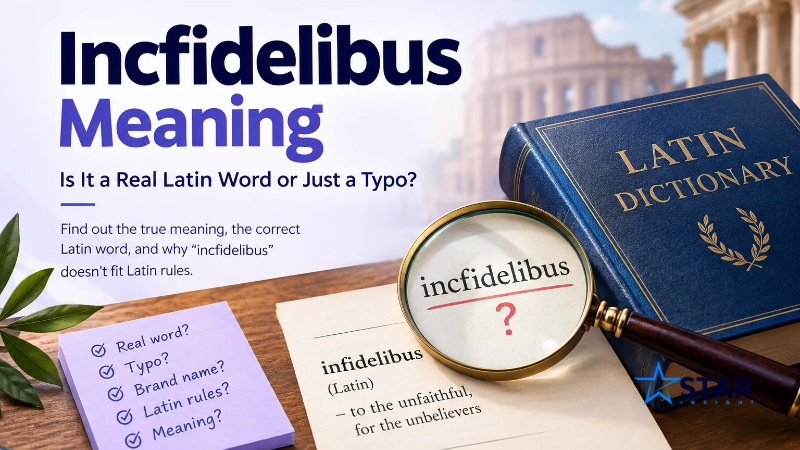
You typed a strange, Latin-looking word into a search bar and got almost nothing useful back. That is exactly what happens with “incfidelibus”, and there is a clear reason why. In this guide, you will learn what the word most likely is, how it relates to real Latin, why it breaks the rules of the language, and how to check any unusual word yourself before you trust it.
What Is the Incfidelibus Meaning?
Here is the short answer: “incfidelibus” is not a recognized word in Latin or English. It does not appear in standard Latin dictionaries, and no established definition exists for it.
That does not mean the word is meaningless to everyone. It could be one of these:
- A typo or misspelling of a real Latin word
- A brand name, username, or domain someone invented
- A blend of the abbreviation “Inc” and a Latin ending
- A garbled word created by autocorrect, copy-paste, or text recognition software
The most helpful clue is how closely it resembles a genuine Latin word. That word is covered next.
Quick Facts at a Glance
- Is it in Latin dictionaries? No
- Is it in English dictionaries? No
- Closest real word: infidelibus
- Most likely explanation: a typo or an invented name
- Safe to assume a meaning? No
Incfidelibus vs. Infidelibus: The Likely Connection
The closest real word is “infidelibus”. The two differ by a single letter: the extra “c” in the middle. Because of this, many people suspect “incfidelibus” is simply a misspelling.
Typos like this are common with long, unfamiliar words. When you type a word you have never seen written before, your fingers and your memory can easily add or drop a letter.
What Infidelibus Means in Latin
“Infidelibus” comes from the Latin adjective infidelis, which means unfaithful, disloyal, untrustworthy, or unbelieving. The ending -ibus marks the dative or ablative plural. In plain English, it can translate as “to the unfaithful,” “for the unbelievers,” or “by the unfaithful,” depending on the sentence.
This is also the root of the English word “infidel.” If you have ever read old religious or historical texts, you may have seen infidelis or a related form without realizing it.
Breaking Down the Parts
Latin words are built from clear pieces. Here is how infidelibus is assembled:
- in-: a prefix meaning “not”
- fidel-: from fidelis, meaning faithful or loyal, which is related to fides (“faith” or “trust”)
- -ibus: a plural ending that shows the word’s role in a sentence
Put together, infidelibus is roughly “not-faithful-ones” in a grammatical form. The structure is regular and well documented, which is why it is easy to verify.
English Words from the Same Root
The Latin root fides shows up in many everyday English words. Seeing them can help you understand why “fidel” feels familiar:
- Fidelity: faithfulness or loyalty
- Infidelity: unfaithfulness
- Confide: to trust someone with a secret
- Confidence: a feeling of trust or certainty
If “incfidelibus” was meant to carry any idea, it would most likely be this family of meanings: faith, loyalty, or the lack of it.
Why Incfidelibus Does Not Fit Latin
Latin has strict spelling and word-building patterns. “Incfidelibus” breaks several of them, which is strong evidence that it is not a real Latin word.
The Prefix Problem
The Latin prefix for “not” is in-, and before the letter “f” it stays as plain “in”, as in infidelis, infirmus (weak), and infinitus (endless). There is no reason to insert a “c”.
You might point out that “inc-” appears in real words such as “incredible” or “incognito.” That is true, but in those words the “c” belongs to the root: in + credibilis and in + cognitus. For “incfidelibus” to work the same way, a root beginning with “cf” would have to exist. In Latin, it does not.
“Inc” Is an English Abbreviation, Not a Latin Prefix
In English, “Inc.” stands for “Incorporated”, as in a registered company. It has nothing to do with Latin grammar. If someone combined “Inc” with “fidelibus”, they were mixing an English business abbreviation with a Latin ending. That can make a catchy brand name, but it does not produce a Latin word with a defined meaning.
No Dictionary Entry Exists
Standard Latin references list infidelis and its forms, but not incfidelibus. When a word is missing from every dictionary and from classical texts, the safest conclusion is that it is not part of the language.
What About “Fidelibus”?
“Fidelibus” is a real Latin form. It comes from fidelis (faithful) and means “to or for the faithful.” You may have seen it in religious or formal Latin phrases.
If someone created “incfidelibus” on purpose, they may have joined “Inc” with “fidelibus” to suggest a company tied to faithfulness or loyalty. That is only a guess, and nothing confirms it. Without a statement from the person who coined it, any meaning is speculation.
Possible Explanations for the Word
Since no official meaning exists, it helps to think about where such a word could come from. Here are the most realistic explanations, from most to least likely.
- A simple typo. One extra letter turns infidelibus into “incfidelibus.” This is the most likely explanation.
- An invented brand or domain. New websites often use made-up words because short, real words are already taken. A Latin-sounding word feels serious and memorable.
- A username or handle. Gamers, writers, and creators sometimes build names from Latin pieces to sound unique.
- A software or copy-paste error. Text recognition tools and autocorrect can scramble unusual words into new ones.
- An intentional blend. Someone may have mixed “Inc” with a Latin word as wordplay.
Notice that none of these give the word a “hidden” dictionary meaning. They only explain how it may have appeared.
Can You Say It Out Loud? A Note on Pronunciation
Because the word is not real Latin, there is no official pronunciation. Still, people usually read it by sounding out the letters, which gives something like “ink-fih-DELL-ih-bus.”
For the real word infidelibus, classical Latin is typically pronounced “in-fi-DEH-li-boos,” while church Latin often sounds closer to “in-fi-DAY-lee-boos.” If you want to be understood by a Latin speaker, use the real word.
How to Check the Meaning of Any Unusual Word
You do not have to trust a random website, including this one. Use these steps to verify any strange word on your own.
- Search in quotation marks. Type “incfidelibus” in quotes and see how many exact matches appear. Very few results usually means the word is rare or invented.
- Check a Latin dictionary. Sites such as Wiktionary and other Latin dictionaries are useful. Search for the closest real spelling, such as infidelis.
- Test spelling variations. Remove or swap one letter at a time. This is how “infidelibus” appears.
- Look at the source. Where did you see the word? A product page, a username, or a domain name often explains it.
- Break it into parts. Try splitting the word into a prefix, a root, and an ending. If the parts do not exist, the word probably does not either.
- Ask a Latin community. Forums for Latin learners can confirm grammar questions quickly and for free.
Common Mistakes When Researching Words
Many people get misled when they look up unusual terms. Avoid these traps:
- Trusting the first result. Some sites invent meanings to attract clicks.
- Assuming that looking Latin means being Latin. A word can sound ancient and still be made up.
- Ignoring context. The place you found the word is often the best clue.
- Skipping a second source. Always confirm a definition with at least two reliable references.
Practical Tips Before You Use the Word
If you plan to use “incfidelibus” as a name, a tattoo, or a title, take these precautions first.
- Do not assume it means something. Without a verified definition, you could be saying nothing at all.
- Check the closest real word. If you meant “infidelibus”, know that it carries the idea of unfaithfulness or disbelief, which may not be the message you want.
- Search for existing uses. Look for trademarks, social media handles, and domain names before you commit.
- Be careful with permanent choices. For anything like a tattoo, have a Latin speaker confirm the phrase first.
- Think about your audience. A name that readers cannot spell or pronounce can be harder to remember and share.
Is Incfidelibus a Good Brand Name?
Made-up words can work well as brand names. They are often easy to trademark, and the matching domain is usually available. Few competing pages means a new site can stand out quickly.
There are drawbacks as well:
- No built-in meaning. Customers get no hint about what you do.
- Hard to spell. People may type “infidelibus” and land somewhere else.
- Possible negative association. The closest real word means “unfaithful,” which may not suit every brand.
- Low search demand. People rarely search for a word they have never heard of, so you will need other keywords to attract visitors.
If you still like the name, pair it with clear descriptive content so that both readers and search engines understand your topic.
Frequently Asked Questions
What does incfidelibus mean?
It has no confirmed meaning. It is not a recognized Latin or English word, and it is most likely a misspelling or an invented term.
Is incfidelibus a Latin word?
No. It resembles Latin, but it is not found in standard Latin dictionaries. The closest real word is “infidelibus.”
What does infidelibus mean?
It is a plural form of the Latin infidelis, meaning unfaithful or unbelieving. It is usually translated as “to or for the unfaithful” or “by the unfaithful,” depending on the sentence.
How do you pronounce incfidelibus?
There is no official pronunciation because the word is not part of Latin. Most people would read it as “ink-fih-DELL-ih-bus.” For the real Latin word, “in-fi-DEH-li-boos” is the classical form.
Can I use incfidelibus as a brand name or domain?
You can, since very few pages use it, which makes it easy to stand out. Check trademarks and domain availability first, and remember that the name has no built-in meaning for customers.
Conclusion
“Incfidelibus” has no confirmed meaning. It looks like a close cousin of the real Latin word “infidelibus”, which means “to or for the unfaithful,” or it may be a name someone made up. Latin spelling rules, the missing dictionary entry, and the English meaning of “Inc” all point toward a typo or a coined term. The key takeaway is to verify before you rely on it. Check the closest spelling, look at where you found the word, and confirm with a trusted Latin source if the meaning matters to you.








Leave a Reply